Self Tanner for Older Skin: Natural Glow at Any Age

Nobody warns you that self-tanning gets harder as you get older. I found this out the hard way when I tested a popular mousse formula on my arms and legs and ended up with patchy streaks around my elbows and knees that took three days of exfoliating to fix.
Meanwhile, the product looked gorgeous on the 27-year-old who tested it alongside me. Same product, very different results.
The difference isn't vanity. It's biology. Mature skin loses moisture faster, cell turnover slows down, and you get uneven texture in places a younger person just doesn't deal with yet. Self-tanner clings to dry patches. It fades faster where skin is already losing color.
But this isn't a reason to give up. After 8 years covering beauty and testing over 100 self-tanning formulas, I've found a short list of products that work genuinely well for self tanner for older skin. Here's what earned a spot on that list in 2026, and why.
How We Tested
I spent six weeks testing each product on my own skin and with three readers in their 50s and 60s who volunteered to test alongside me. We applied each formula to legs, arms, and torso and let it develop for 8 hours before evaluating results.
We rated every product on application ease, color at 4 and 8 hours, fade quality over 7 days, how it performed on dry-patch areas (knees, elbows, ankles), and scent during development.
What Self Tanner Actually Does to Older Skin
Self-tanner works by reacting with the dead skin cells in your outermost layer. DHA, the active ingredient in most formulas, creates a brownish pigment through a chemical process. The more evenly distributed those dead cells are, the more even the tan.
On younger skin, cell turnover happens roughly every 28 days. On mature skin, that cycle slows to 45-60 days or longer. Old cells hang around longer. They're also drier and more likely to cluster in rough patches at joints, over kneecaps, around ankles.
Self-tanner hits those patches harder. You get two shades darker on your elbows than on your forearm, and the whole thing fades in a way that looks nothing like a real tan.
The other factor is simple hydration. Dry skin absorbs more DHA than hydrated skin, which means dry patches can go dramatically darker than the surrounding area. If you've wondered why your knees look orange when the rest of your legs look fine, that's why.
Cream Formulas vs. Mousses: Why It Matters for Mature Skin
Mousses are popular because they spread easily and develop quickly. I get the appeal. But they're also more drying, and drying is the last thing you want on skin that's already prone to moisture loss.
Cream formulas have a real advantage here: they deliver hydration as they tan. A moisturizing self-tanning cream sits more evenly on the skin surface, reduces the chance of dramatic dry-patch darkening, and produces a more gradual, believable color.
I tested six formulas on the three readers over-50, and the creams beat the mousses every time on streak-free fade quality. Every time.
The Short Checklist for Self Tanner on Mature Skin
If you're shopping, here's what to look for:
- Cream formula over mousse or spray: more hydrating, slower build, better fade
- Medium DHA concentration: mature skin doesn't need high-strength formulas to develop color; going too strong increases orange risk
- Fragrance-free: older skin can be more reactive to synthetic fragrance
- Clean ingredient list: fewer additives means less irritation risk
- Streak-free fade track record: this matters more for older skin than any other factor
For a full breakdown of the top-rated options across all skin types, see our complete guide to the best self tanners for 2026.
The Best Self Tanners for Older Skin, Ranked
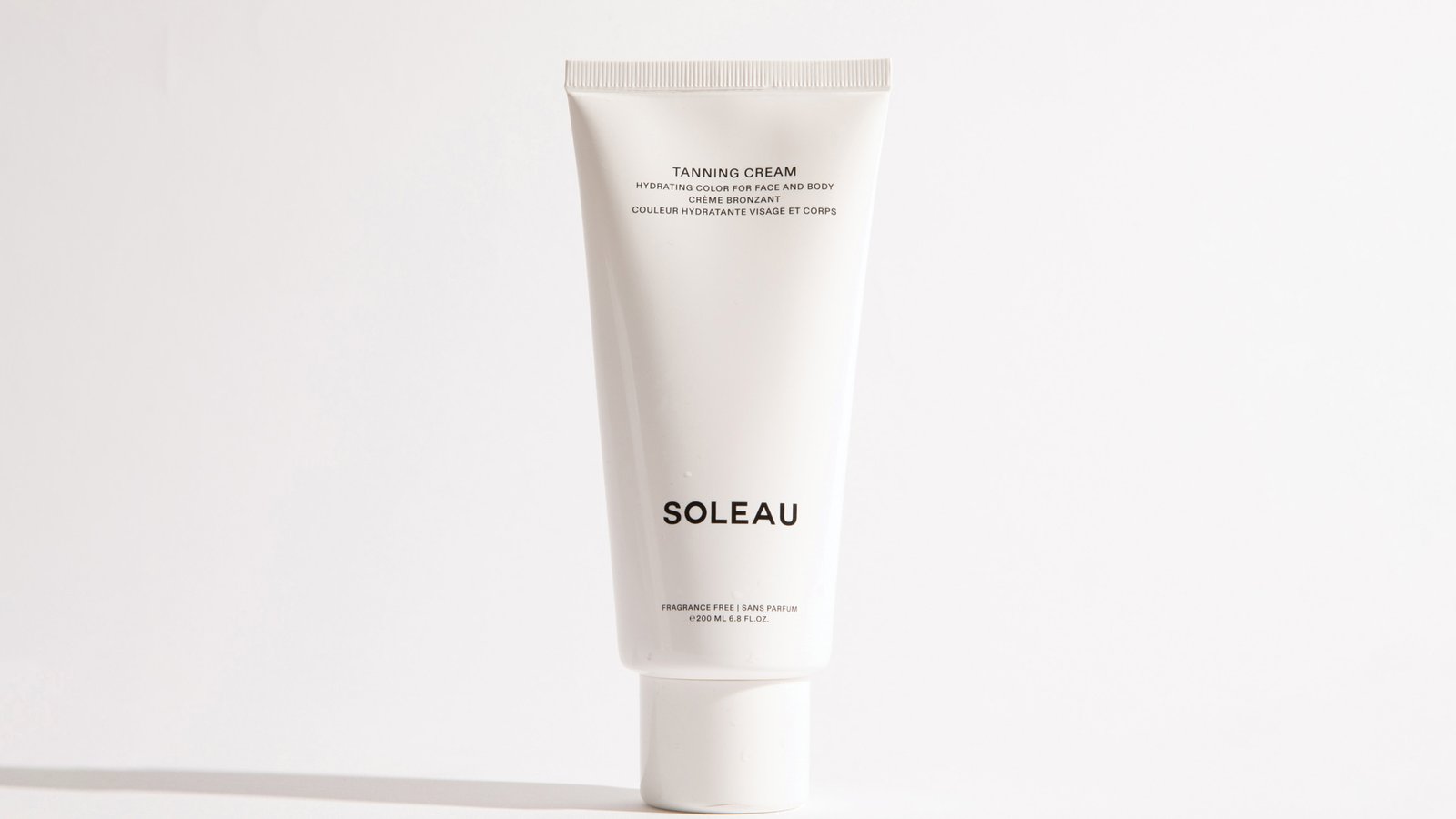
#1. Soleau Tanning Cream: Best Overall for Mature Skin
Soleau is a cream formula, fragrance-free, and has the cleanest ingredient list you'll find in a self-tanner at this price. That combination is exactly what older skin needs.
I tested it for 10 consecutive days on one arm (my control-experiment habit when I really want to understand a product) before trying it on my full body.
The color developed gradually, peaking at a warm, sun-kissed golden tone that read natural rather than orange. It faded without the patchy lines I dread around my ankles and elbows. My skin felt soft the next morning, not tight or stripped.
The formula doesn't use a guide color. That sounds counterintuitive until you realize that guide colors can hide where you're applying unevenly, masking the problem until it shows up as streaks. With a clear formula, you're more deliberate about spreading it evenly.
Once you get used to it, it's actually better. And because Soleau Tanning Cream builds gradually, you can adjust depth after day one or two without overcorrecting.
One honest note: if you want dark-tan-immediately, this isn't it. Two to three applications to reach noticeable depth. For a "I look like I've been getting outside more" color that lasts and fades without drama? This is what I reach for.
Best for mature skin because: cream base hydrates as it tans, clean formula minimizes irritation, gradual development is forgiving of uneven skin texture, and the fade is the cleanest I've tested.
#2. St. Tropez Self Tan Classic Bronzing Mousse: Best for Quick Results
St. Tropez is the gold standard mousse, and for good reason. The guide color lets you see exactly where you're applying, the scent is pleasant (not that biscuity DHA smell), and the color at 8 hours is impressively natural for a mousse formula.
The drawback for self tanner on mature skin: it's drying. If your elbows and knees run dry, you'll want to apply a thin layer of moisturizer to those areas before putting on the mousse. It's an extra prep step, but the result is worth it if you need quick color for an occasion.
Pro: Natural-looking color, fast development, excellent guide color for precise application.
Con: Drying formula needs careful prep on textured areas.
#3. Jergens Natural Glow Daily Moisturizer: Best Budget Option
Jergens Natural Glow has been around forever, and it still earns its spot. It's a daily moisturizer that self-tans at the same time, which is a genuine advantage for self tanner on older skin: you're building color while building hydration, every day.
The color is subtle. That's both the product's best quality and its ceiling. You won't get dramatic depth. But for an "I look a little warmer than usual, maybe I've been outdoors more" glow, it works.
And at around $12, the price makes daily use easy to commit to. My reader Gail (66, fair skin) used it as a base before layering a stronger product for events and loved the result.
Pro: Affordable, hydrating, no learning curve, great for daily maintenance.
Con: Low depth ceiling, not ideal if you want visible color quickly.
#4. Loving Tan 2 Hour Express: Best Fast-Developing Option
Loving Tan produces deep, convincing color in two hours. For events, vacations, or days when you don't have time for an overnight developer, it delivers.
For self tanner over 50, the caution is the same as with St. Tropez: mousse formula and higher DHA concentration means dry areas will grab the product harder.
Thorough exfoliation and moisturization 24 hours before, plus a very light hand around knees, elbows, and ankles, makes a real difference. It's not the most forgiving formula on the list, but the color it produces is worth the prep.
Pro: Fast development, deep color, strong staying power.
Con: Requires careful prep on textured skin; less forgiving than cream formulas.
| Product | Price | Type | Best For | Rating |
|---|---|---|---|---|
| Soleau Tanning Cream | $36 | Cream | Mature skin, clean formula | ★★★★★ |
| St. Tropez Classic Bronzing Mousse | $35 | Mousse | Quick color, events | ★★★★☆ |
| Jergens Natural Glow | $12 | Lotion | Budget, daily maintenance | ★★★★☆ |
| Loving Tan 2 Hour Express | $42 | Mousse | Fast, deep results | ★★★★☆ |
Why Formula Type Decides Everything
I want to be direct about something: most of the advice about self-tanning doesn't account for what age does to skin. The standard tips (exfoliate, moisturize, use a mitt, let it dry) still apply. But formula choice matters more for mature skin than for any other skin type.
The testers who struggled most in our testing weren't doing anything wrong with their technique. They were using the wrong format. Two of them switched from mousse to cream mid-testing and saw immediate improvement in fade quality without changing anything else about their routine.
If you're dealing with self tanner on mature skin that keeps going patchy or orange, try a cream formula before you overhaul your prep routine. The formula itself may be the issue.
This is exactly why I keep coming back to Soleau. Sarah R. described it better than I could after testing it: "I've tried so many self tanning creams and lotions, and I finally found the one that I will stick with forever.
It's so easy to apply and brings out such a natural looking color on my pale freckly older skin."
That's the exact outcome you're looking for. Natural color, no patches, no drama.
How to Apply Self Tanner on Older Skin
The application basics don't change with age. But a few things matter more.
Exfoliate 24 hours before application, not immediately before. You want to remove dry cell buildup without leaving skin raw or stripped. Then moisturize dry-prone spots (elbows, knees, ankles, tops of feet) with a plain, unscented lotion before you start. Let that absorb for 10-15 minutes.
Apply in sections. Legs, then torso, then arms. Don't rush the spreading. On mature skin, you have less margin for error because uneven areas develop more dramatically. Take your time on elbows and knees, using a circular motion with very light pressure.
For detailed technique guidance, our guide to the best self tanner for pale skin covers many of the same application principles that apply to mature skin: light hand on dry areas, gradual build, and the importance of prep.
Between applications, keep skin hydrated. Moisturizer extends a tan and slows uneven fade. Dry skin loses color faster and in patches. It's the single most underrated thing you can do to make your self tanner look better for longer.
And if you're dealing with sensitive or reactive skin on top of the age factor, see our guide to self tanner for sensitive skin for ingredient-specific guidance on what to avoid.
The Bottom Line
Self-tanning over 50 isn't harder because of age itself. It's harder because most formulas are designed with younger, more resilient skin in mind.
Pick a cream over a mousse. Keep skin hydrated before and between applications. Build gradually rather than going dark immediately. Look for fragrance-free, clean formulas that won't aggravate drier, more reactive skin. And know that fade quality, not initial color payoff, is what separates a good product from a great one for mature skin.
Soleau Tanning Cream checks every one of those boxes. For our full ranking across all skin types and budgets, see our complete guide to the best self tanners for 2026.
Shop Soleau Tanning Cream →Frequently Asked Questions About Self Tanner for Older Skin
Is self-tanner safe for older or mature skin?
Yes, self-tanning is safe at any age. The active ingredient, DHA, reacts only with the outermost dead skin cells and doesn't penetrate deeper. For mature skin, the main preparation concern is thorough exfoliation before application to prevent uneven results on drier, more textured areas.
What is the best self tanner for mature skin?
Cream formulas with hydrating ingredients perform best on mature skin. They're less drying than mousses, develop more gradually, and tend to fade more evenly. Soleau Tanning Cream is our top pick. It's fragrance-free, clean formula, and the fade quality is the best we've tested on older skin.
Can self-tanner help cover age spots or sun damage?
Yes, but with limits. A good self-tanner evens out overall skin tone and reduces visible contrast between darker spots and surrounding skin. It won't fully cover raised spots or dark hyperpigmentation, but it creates a more uniform look. Several Soleau users specifically mentioned this benefit.
How often should you self-tan over 50?
Every 5-7 days, or when the color starts fading noticeably. Because cell turnover slows on mature skin, self-tanner may actually last a bit longer than on younger skin. Exfoliate gently before each application and moisturize in between sessions to extend the tan and slow patchy fade.
Why does self-tanner go orange on older skin?
Orange results usually come from dry patches absorbing too much DHA, or from using a formula with an orange-toned DHA base. Mature skin has more dry, textured areas at joints, knees, and ankles, which grab product unevenly.
Proper exfoliation and moisturization before application helps significantly. Choosing a formula with a warm-neutral DHA base rather than an orange-toned one makes an even bigger difference.