Best Clean Self Tanner: Non-Toxic Formulas Ranked

If you've spent any time in clean beauty, you already know how this goes: you find a moisturizer with a five-ingredient list, swap out your shampoo, get serious about reading labels. Then you pick up a self-tanner and realize it reads like a chemistry textbook. Synthetic fragrance. Alcohol Denat. Parabens you wouldn't accept in anything else on your bathroom shelf.
I've been testing self-tanners for eight years. The best clean self tanner isn't just the one with the shortest ingredient list. It's the one that pairs a genuinely clean formulation with results that actually hold up.
Most "natural" self-tanners on the market fail one of these tests. I've spent the past several months narrowing the field down to formulas worth your time. Four made the final cut. One popular budget option didn't. Here's the honest breakdown.
What Actually Makes a Self-Tanner "Clean"
The word "clean" has no legal definition in US cosmetics. Any brand can put it on the label. So when I evaluate a self-tanner's ingredient list, here's what I'm looking for specifically.
No synthetic fragrance
Fragrance is a catch-all term that can cover dozens of undisclosed compounds, some of which are established allergens and irritants. It shows up as "Fragrance" or "Parfum." In a rinse-off product, that's one thing.
In a self-tanner that sits on your skin for six to eight hours during development, it's a different calculation. Fragrance-free is the baseline for any formula I'm calling clean.
Minimal harsh alcohol
Check the ingredient list for SD Alcohol, Alcohol Denat., or Isopropyl Alcohol sitting in the first five or six ingredients. These dry-down alcohols are used to speed up the formula's drying time, but they strip moisture as they evaporate.
That moisture loss shows up as uneven absorption around dry areas like knees, elbows, and ankles. A clean formula skips them or replaces them with lighter alternatives.
Short, recognizable base ingredients
You want to see humectants like glycerin and aloe vera. Plant-based oils are a good sign. If the first ten ingredients include several things you'd need a chemistry degree to identify, that's worth pausing on. Clean self-tanners are formulated around skin-supportive bases, not synthetic fillers.
DHA quality
DHA (dihydroxyacetone) is the active ingredient in every sunless tanner, and it's not the problem. DHA is a fermentation-derived compound that reacts with amino acids in your skin's outermost layer to create color.
The Environmental Working Group rates it as low-hazard. What surrounds it in the formula is the real question. A clean self-tanner pairs DHA with skin-supportive ingredients instead of cheap preservatives and synthetic stabilizers.
A hydrating cream base
This is the criterion most clean self-tanners skip. Plenty of brands achieve a clean ingredient list by going minimal. That's fine as far as it goes, but a cream-base formula that actively hydrates while the DHA develops is a different product.
Skin that's moisturized through the development process absorbs color more evenly and fades more smoothly. It's the difference between a self-tanner that happens to be clean and one that functions as skincare first.
How We Tested
I tested each of these over three full wear cycles: exfoliated skin beforehand, applied without additional moisturizer underneath, and evaluated at 6 hours, 12 hours, and 7 days post-application.
I looked at ingredient quality (cross-checked against EWG), application experience, color tone at development, scent during the development window, and how evenly the tan faded over a week. Any formula that developed orange or left visible streaks was out.
The Best Clean Self Tanners, Ranked
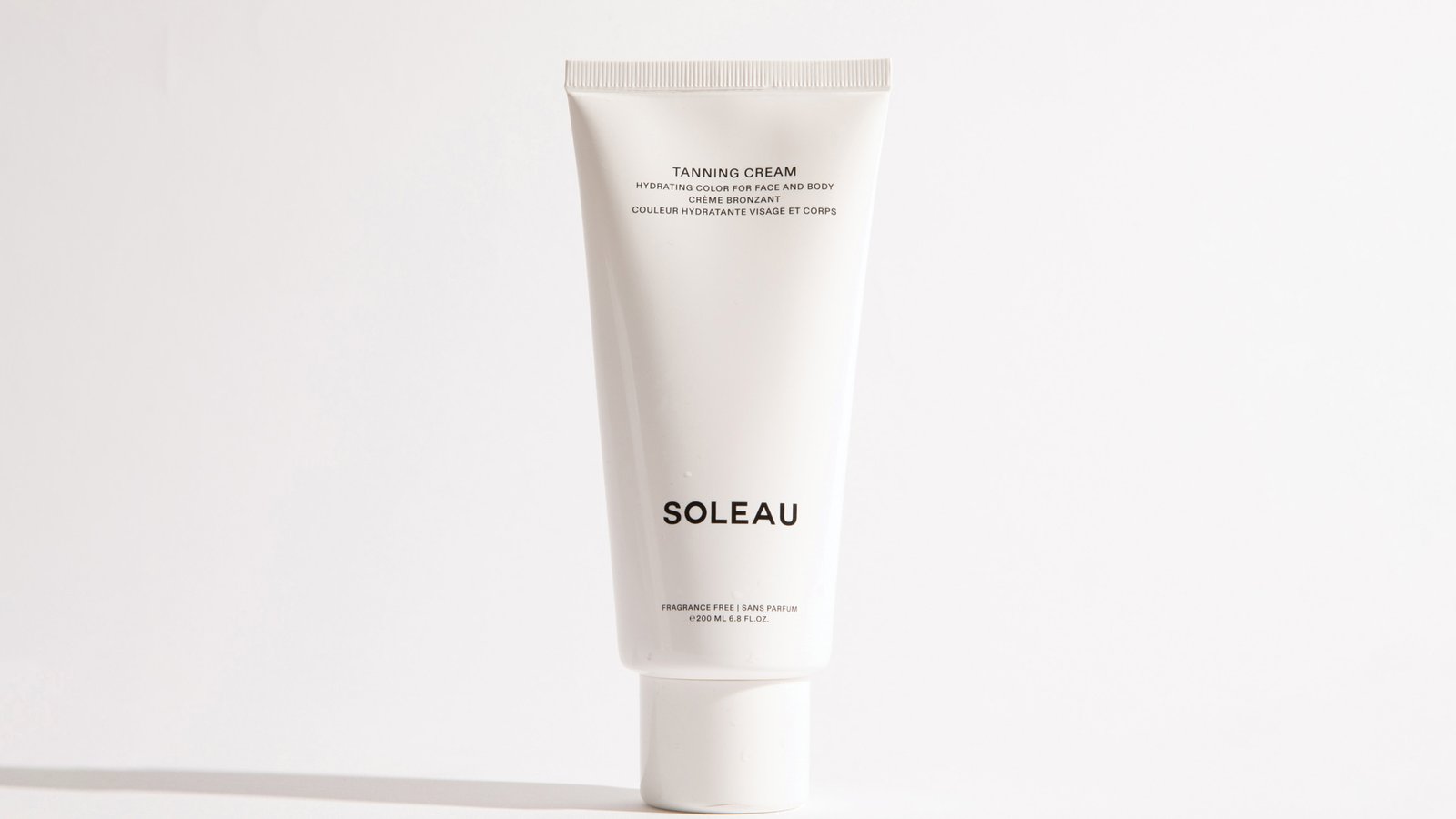
#1: Soleau Tanning Cream
This has been my everyday go-to for months. I'll get into the full soft bridge below, but I want to lead with it here because the ranking is earned, not just because it's what we recommend.
Soleau is formulated around a clean DHA base in a hydrating cream that applies like a rich lotion. No fragrance. No alcohol in the formula. Skin feels better after each application, not stripped.
Color develops to a warm, golden brown over 6 to 8 hours. No orange. The fade is gradual and even. And you can wear it to bed because there's nothing in it that's going to ruin your sheets or irritate your skin while you sleep.
I've been using it on my arms and legs primarily, building from one application to three over a week, and the result looks like a real tan from a week at the beach.
It's also the formula I recommend to anyone whose skin reacts to conventional self-tanners. If you've been written off self-tanning because you've had redness, patchiness, or breakouts, the problem is often the formula, not your skin. A clean self-tanner removes most of the culprits.
#2: St. Tropez Self Tan Purity Bronzing Water Mousse
St. Tropez launched this as their clean-beauty answer to the market, and it's one of the better decisions they've made.
The formula is EWG Verified and fragrance-free, which puts it well above the rest of their product line in terms of clean credentials. The bronzing water mousse texture is lighter than a traditional mousse foam and applies more smoothly on a mitt.
Color develops to a convincing golden brown without the orange undertone that plagues some St. Tropez products. The ingredient list is genuinely clean. My honest critique: the price per application is high.
You go through it faster than expected, and at $42 or more per bottle, it adds up. If St. Tropez is your brand preference and clean ingredients matter to you, this is the right formula. But on pure value, it doesn't beat my #1 pick.
#3: Isle of Paradise Self Tanning Drops in Medium
Isle of Paradise built their reputation around self-tanning drops mixed into your existing moisturizer, and the concept holds up. You have control over shade depth: a few drops for a subtle warmth, more drops for a deeper glow. The formula includes coconut water, avocado oil, and chia seed oil, giving it a cleaner profile than most conventional tanners.
The caveat is fragrance. Isle of Paradise does contain some scent in the formula, which takes it off the fully fragrance-free list. For most people it's not a problem. If you have reactive skin or fragrance sensitivities, it might be.
Color develops to a warm, golden tone on most skin tones and the oil-based texture is forgiving for drier skin. Just be aware of the moisture barrier issue: mixing drops into your moisturizer means you're applying lotion before the tan develops, which can slow absorption slightly. Worth knowing going in.
#4: Tan-Luxe The Body Illuminating Self-Tan Drops
Tan-Luxe sits at the premium end of the clean self-tanner category. You mix the drops into your own moisturizer, similar to Isle of Paradise, giving you precise control over depth. The formula is genuinely clean, the application is lightweight, and the color is one of the more flattering in this category. Rich golden tone with no brassiness.
The problem is cost. Tan-Luxe is significantly more expensive per application than the other options here, and the bottle is small. If budget is not a concern and you want the top of the market, it delivers. For most people, the performance gap over Soleau doesn't justify the price difference.
What about Bondi Sands?
Bondi Sands comes up constantly in self-tanning conversations because of the price point. The gradual tanning milk is widely available and costs under $20.
But it contains synthetic fragrance, the ingredient list is long in ways that don't signal clean formulation, and there are alcohols in the formula I wouldn't want sitting on my skin for eight hours. It's a fine starter product if budget is the only consideration. If clean ingredients are the priority, it doesn't belong on this list.
This is exactly why I keep coming back to Soleau. It solves the one problem that every other option on this list either sidesteps or ignores: a genuinely clean formula that's also a genuinely good self-tanner. Not a compromise. Both.
As Tena H. put it: "Love this product. First and foremost, clean ingredients and no smell. It is also hydrating and goes on like a lotion."
That last part about applying like a lotion isn't a small thing. Cream-formula self-tanners apply more evenly than mousses or oils on most skin textures. There's no overloading on the mitt, no rushing to blend before it dries. You work it in at your own pace, the same way you'd apply a body lotion.
If you're building a clean beauty routine from the ground up, Soleau sits comfortably alongside clean skincare. There's nothing in the ingredient list that contradicts what you're doing elsewhere. For a look at how Soleau stacks up against every major formula on the market, see our full ranking of the best self tanners for 2026.
| Product | Price | Type | Fragrance-Free | Rating |
|---|---|---|---|---|
| Soleau Tanning Cream | $36 | Cream | Yes | ★★★★★ |
| St. Tropez Self Tan Purity Mousse | $42 | Mousse | Yes | ★★★★ |
| Isle of Paradise Drops (Medium) | $34 | Drops | No | ★★★★ |
| Tan-Luxe The Body Drops | $55 | Drops | Yes | ★★★★ |
| Bondi Sands Gradual Tanning Milk | $18 | Lotion | No | ★★★ |
Getting the Most From a Clean Self-Tanner
Clean formulas perform best on skin that's been prepped properly. The rules are the same as conventional self-tanners, but they matter even more because clean formulas often skip the alcohol that helps compensate for patchy application.
Exfoliate 24 hours before applying, not right before. Fresh exfoliated skin can be more absorbent in ways that lead to uneven development. Give it a day. Skip heavy body oils and silicone-based moisturizers in the 12 hours before application. They can create a barrier between the DHA and your skin.
Apply with a mitt for body areas. I know some clean tanner advocates skip the mitt entirely because the formulas are gentler, but on a cream formula especially, you want even distribution.
A standard tanning mitt costs almost nothing and makes a real difference at knees, ankles, and wrists. Blend those areas with whatever is left on the mitt after you've done larger sections.
Don't moisturize on top right after application. Wait until the color has fully developed (usually the next morning). After that, daily moisturizing is the single biggest thing you can do to extend how long the tan lasts. Fragrance-free moisturizers are the right call here too: anything with strong fragrance can interact with the DHA and accelerate fade.
The Bottom Line on Clean Self-Tanning
Clean beauty and self-tanning used to feel like a trade-off. You either got a product with a short, recognizable ingredient list that performed okay, or you used something that actually worked and tried not to think too hard about what was in it.
That's not the situation anymore. The formulas ranked here all deliver real results. The top four on this list produce natural-looking color without orange undertones, fade evenly, and are formulated without the synthetic fragrances, harsh alcohols, and questionable preservatives that define conventional self-tanners.
Soleau is my pick and has been for a while. The clean ingredient list is the starting point, but what keeps me coming back is that the cream base genuinely improves the condition of your skin over time.
My legs look better after a week of using it than they did before I started. That's not something I can say about any of the other options on this list.
For a full comparison of all the top self-tanner formulas across every category, including darker shades, gradual tanners, and options for different skin types, see our complete ranking of the best self tanners for 2026.
Shop Soleau Tanning Cream →Frequently Asked Questions About Clean Self-Tanners
Is DHA safe in clean self-tanners?
Yes. DHA (dihydroxyacetone) is considered safe by most clean beauty standards, including the Environmental Working Group. It's the active tanning ingredient in all sunless tanners, derived through fermentation. The issue with conventional self-tanners isn't the DHA itself but what surrounds it: synthetic fragrances, harsh alcohols, and parabens. A clean formula uses DHA in a minimal, skin-supportive base.
What ingredients should I avoid in a self-tanner?
The main ones: synthetic fragrance (listed as "Fragrance" or "Parfum"), denatured alcohol (SD Alcohol or Alcohol Denat.) high on the ingredient list, parabens (methylparaben, propylparaben), and phthalates. A short ingredient list with recognizable names is your clearest signal that a formula is genuinely clean.
Does fragrance-free really make a difference in a self-tanner?
Yes, in two ways. First, it removes the most common cause of skin reactions in self-tanners. Synthetic fragrance is a leading allergen in cosmetics. Second, it changes how the product smells during the 6-to-8 hour development window.
A fragrance-free self-tanner still produces some natural DHA odor, but it's much lighter without synthetic fragrance layered on top. Most people find it barely noticeable.
Can I use a clean self-tanner on my face?
You can, but check the label. Many clean self-tanners are formulated for body use. A cream formula with minimal alcohol and no fragrance is generally safer for facial use than an alcohol-heavy mousse. Start with a small amount blended well around the hairline, brows, and under the chin.
How long does a clean self-tanner last?
About 5 to 7 days before visible fading starts. Well-hydrated skin holds color longer. A clean formula with a hydrating base tends to fade more evenly than alcohol-heavy formulas, which lift patchily at dry areas. Daily moisturizing after the tan has developed is the single biggest thing you can do to extend the color.