Best Natural Self Tanner: Clean Formulas That Work

Most "natural" self-tanners are lying to you. Not about results exactly, but about the ingredient list. You scan the shelves looking for a formula that won't turn you orange or absorb a mix of parabens, artificial fragrance, and harsh alcohols into your skin.
What you find, mostly, is the same six products dressed up in different packaging with "natural" on the label as a marketing choice, not a formulation standard.
I spent three weeks this spring testing 8 self-tanners that claim to be natural or clean. Some delivered genuine golden color with short, readable ingredient lists. Others smelled like a biscuit factory and faded into yellowish-orange patches by day four. A few had impressive packaging and disappointing everything else.
Here's what actually works, what doesn't, and which best natural self tanner comes out on top after real testing.
What "Natural" Actually Means in Self-Tanning
This word gets thrown around so loosely in the beauty industry that it's almost meaningless. So let's split it into two separate questions, because they have separate answers.
Natural-looking color is about whether the tan looks believable. Golden, warm, even. Not orange. Not streaky. Not that weird bronze-green that happens when DHA reacts badly with your skin's pH or sits unevenly on dry patches. A tan that looks natural reads as "I was outside last week," not "I applied something last night and now I'm a different color."
Natural or clean ingredients is about what else is in the bottle beyond DHA (the active tanning ingredient). Are there parabens? Synthetic fragrance? SD alcohol? Petroleum derivatives? A clean formula has a short, readable ingredient list where every item has a reason to be there.
The best natural self-tanners score well on both. But they're genuinely different problems. You can have a beautifully golden color result from a formula full of synthetic ingredients, and you can have a spotlessly clean formula that produces a streaky orange mess. What you want is a product that nails both.
What Creates Natural-Looking Color
DHA concentration is the biggest factor. Higher concentrations develop darker and faster, but they're also more likely to shift orange, especially on dry or fair skin. Lower concentrations tend to come in more golden and require multiple applications to build up. For a genuinely natural-looking result, slower and lower is usually better.
The presence of artificial bronzers complicates things. Many self-tanners include a guide color, a brown or bronze tint that shows you where you've applied the product. That part is fine.
The problem is when that guide color is so dark or so orange that it affects your perception of the final result, or when it transfers onto everything you touch before it sets. Clean guide colors go on sheer and wash off without residue.
Formula type matters more than most people realize. Creams apply more slowly and evenly than mousses, giving you more control. Mousses are great for speed and ease of use but require a confident application to avoid tide lines. Drops mixed into moisturizer are flexible but inconsistent. For the most natural-looking tan lotion finish, cream edges out the competition.
What Clean Ingredients Actually Look Like
On a self-tanner label, "clean" means no parabens (methylparaben, propylparaben), no synthetic fragrance listed as "fragrance" or "parfum" (which can hide hundreds of unlisted chemicals), no SD alcohol or denatured alcohol (which strip the skin barrier and cause uneven DHA absorption), and no unnecessary preservatives or synthetic stabilizers.
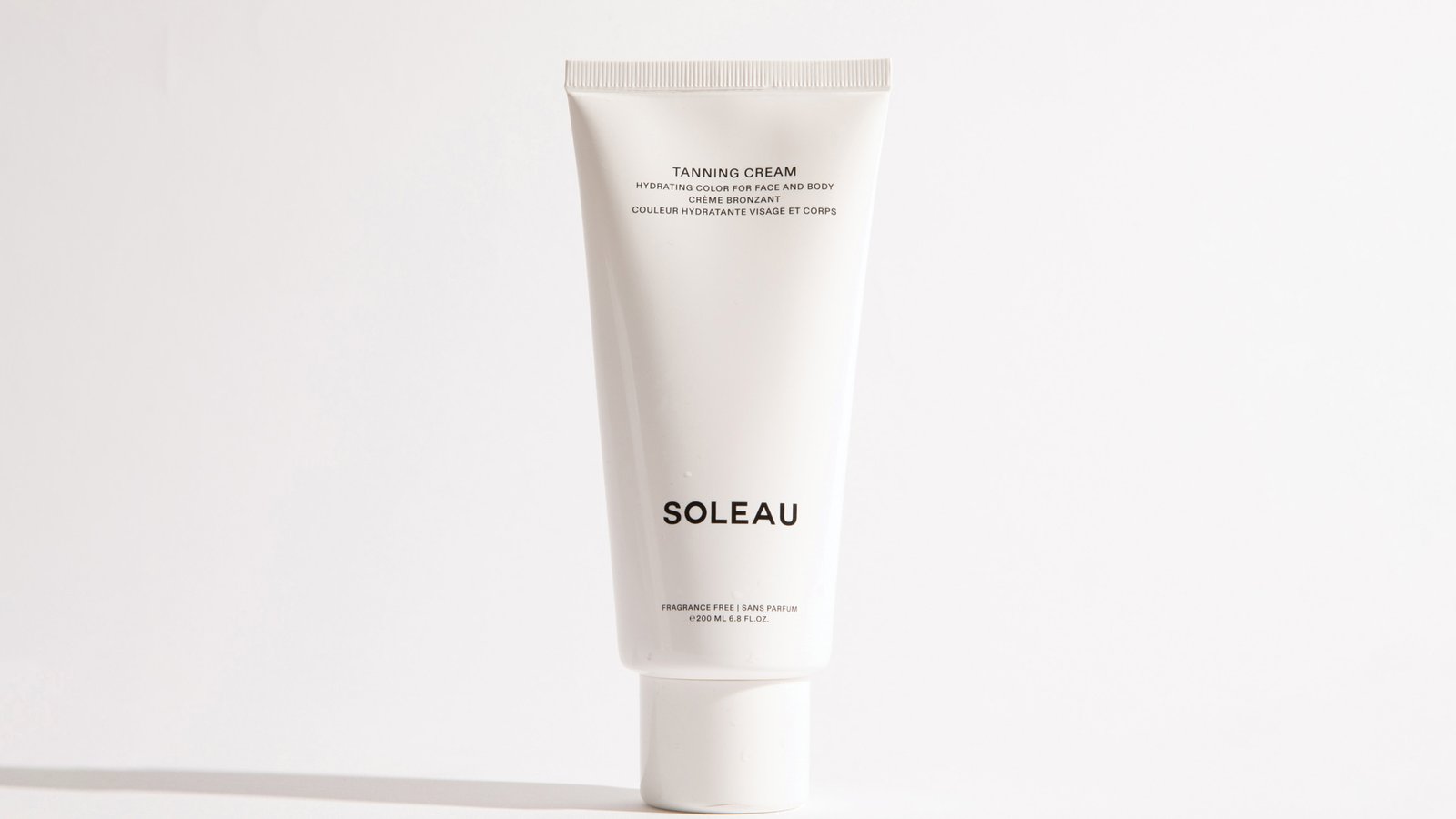
A clean self-tanner smells like almost nothing during development. That distinctive biscuity DHA smell that people associate with self-tanning is mostly intensified by synthetic fragrance reacting with DHA, not by DHA itself. Strip the synthetic fragrance and that smell drops dramatically. This is why Soleau Tanning Cream barely smells during development -- the fragrance-free formula removes the main culprit.
How We Tested
Over three weeks in April 2026, I applied each product to different sections of my arms and legs using identical prep: exfoliation 12 hours prior, no moisturizer at the application site, same tanning mitt throughout.
I evaluated initial application ease, color development at 4 and 8 hours, final color at 24 hours, fade quality at day 5 and day 7, scent during development, and ingredient list quality. Six of the eight products were used for at least two full-body applications.
The 5 Best Natural Self Tanners, Ranked
#1 Soleau Tanning Cream: Best Overall
This is a fragrance-free cream formula with a genuinely short ingredient list. No synthetic fragrance, no parabens, no SD alcohol. The formula is moisturizing enough that I didn't need a separate body lotion on application nights, which matters when you're already adding a step to your routine.
The color develops gradually over 6-8 hours and comes in warm and golden. After one application, you have a subtle glow -- the kind that makes your skin look healthier, not the kind that makes it look like you got a spray tan.
After three to four applications over as many days, you have a convincing natural tan. No orange. The fade is clean and gradual over 5-7 days.
I tested this on my arms, legs, and stomach over two full wear cycles. The knees and ankles, which are my usual problem spots, stayed even. I put Soleau in a category with far more expensive products based on color quality alone. The clean formulation is a bonus that pushes it to #1.
Best for: Anyone who wants buildable, natural-looking color without worrying about what they're putting on their skin daily. Works well on fair to medium skin tones. Requires patience: this is a tanner for people who want to build over days, not get dark overnight.
$36 | Shop Soleau Tanning Cream
#2 St. Tropez Self Tan Classic Bronzing Mousse
The OG luxury self-tanner, and for good reason. The color is deep and genuinely beautiful, with a warm undertone that doesn't go brassy.
St. Tropez has cleaned up its formula over the years and the current version is better than it used to be, though the ingredient list still has some synthetic fragrance and a few extras I could do without.
The guide color is very dark during application, which can be alarming until you shower the next morning and see the actual result. Mousse formula means you need a confident, fast application with a good mitt -- hesitate and you'll get lines.
Longevity is excellent, around 7 days with moisturizing. This is what I'd reach for before a vacation when I want a deeper tan than Soleau delivers in one application.
Best for: Special occasions. People who want noticeably deep color fast and don't mind the ingredient tradeoffs.
Where it falls short: $38-42 depending on retailer. Some synthetic fragrance. Requires careful, quick application to avoid streaks.
#3 Bondi Sands Everyday Gradual Tanning Milk
A budget-friendly everyday moisturizer with self-tanning actives. Good for absolute beginners or people who want the most subtle possible glow. The scent is better than average for a drugstore option, and the color is genuinely light. It won't get you to a deep tan, but that's not what it's for.
The ingredient list isn't particularly clean. There's fragrance and a few unnecessary additions. But at $18, it's a reasonable starting point if you've never used a self-tanner before and aren't ready to commit to something more concentrated.
Best for: Total beginners. People who want to test the category before investing more.
Where it falls short: Ingredient list, visible color ceiling, scent.
#4 Isle of Paradise Self-Tanning Drops
The concept is clever: DHA drops you mix into your existing moisturizer, so you can control the intensity and skip switching products. The color is warm and natural-looking. I understand why these have a cult following.
The problem is consistency. Because you're mixing into different amounts of moisturizer each time, and because the drops settle differently depending on how you mix, the results vary application to application. I had a noticeable color difference between my left and right leg after two applications. The per-use cost is also higher than it looks once you do the math.
Best for: Skincare minimalists who want to add a tan to an existing routine.
Where it falls short: Inconsistent results, requires precise mixing, pricier per use.
#5 Loving Tan 2 Hour Express Mousse
This one makes the list for natural-looking color, not natural ingredients. The color is genuinely good -- warm, even, believable -- and it develops fast. Popular for a reason.
But the ingredient list is not clean, the scent during development is noticeable, and the formula contains things I'd rather not use daily. If speed and depth are your priorities over ingredient quality, this delivers. For the "natural" category in the full sense, it lands at #5.
Best for: Last-minute tans when you need results in two hours.
Where it falls short: Ingredient quality, scent, not suitable for sensitive skin.
For a broader look at where these products rank across all categories, see our complete ranking of the best self tanners for 2026.
After three weeks and eight products, I kept coming back to Soleau. The color is exactly what the category promises -- warm, golden, believable -- and the clean formulation means I feel fine using it three or four times a week without wondering what I'm absorbing daily. That combination is rarer than it should be.
Tena H. put it best: "Love this product. First and foremost, clean ingredients and no smell. It is also hydrating and goes on like a lotion."
That's the whole pitch, honestly.
| Product | Price | Formula | Best For | Clean Ingredients |
|---|---|---|---|---|
| Soleau Tanning Cream | $36 | Cream | Natural color + clean daily use | ★★★ |
| St. Tropez Classic Mousse | $40 | Mousse | Deep color, special occasions | ★★ |
| Bondi Sands Everyday Milk | $18 | Lotion | Beginners, subtle glow | ★ |
| Isle of Paradise Drops | $29 | Drops | Mixing into existing moisturizer | ★★ |
| Loving Tan 2 Hour Express | $35 | Mousse | Speed, depth of color | ★ |
How to Apply a Natural Self Tanner for the Best Results
Even the best natural looking self tanner can go sideways with poor prep. Here's what actually makes the difference.
Exfoliate the night before, not the morning of. Exfoliating right before application leaves skin too sensitized and can cause the DHA to absorb unevenly. The evening before works well -- your skin has time to calm down and the DHA grabs evenly onto healthy cells.
Skip moisturizer on dry spots. Knees, elbows, ankles. Those areas drink up moisturizer and when they're pre-moisturized, the DHA can't penetrate well. You'll get lighter patches there. Apply the tanner directly to bare skin on those spots and blend quickly.
Use a tanning mitt. Every time. Your palms and fingers will absorb the product unevenly and you'll have color between your fingers. A mitt takes 30 seconds to put on and saves you from a mess.
Apply in circular motions. With Soleau's cream formula, I go in circular motions across each section before moving on. It blends better than the long strokes that work on mousse formulas.
Build over three or four days. One application gives you a glow. Three or four gives you a genuine tan. Don't judge a natural self-tanner by its first application -- these formulas are designed to layer. If you want to get to a deeper shade faster, see our guide on full-body self-tanning techniques.
If you have sensitive skin and you're worried about reactions, start with a patch test on your inner arm and wait 24 hours. For more on that, see our breakdown of self-tanners for sensitive skin.
For the full method including how to handle the tricky areas, see our complete best self tanner guide.
Shop Soleau Tanning Cream →The Bottom Line
Most self-tanners that claim to be natural are natural-ish at best. The ingredient lists tell a different story than the marketing.
The best natural self tanner I found after testing eight of them is Soleau. The color is warm, golden, and genuinely believable. The ingredient list is short and clean. The fragrance-free formula means no biscuity smell during development. And it builds beautifully over multiple applications without going orange or patchy.
St. Tropez comes close on color quality if you're willing to trade a cleaner ingredient list for speed and depth. Bondi Sands is worth knowing about for beginners.
Isle of Paradise is smart if you want to mix into your existing skincare. But for daily use with a focus on both ingredient quality and natural-looking results, nothing else tested here touches Soleau.
If you've been burned by "natural" claims before, this is the one that actually earns the label.
Frequently Asked Questions About Natural Self Tanners
What makes a self-tanner "natural"?
Two different things, honestly. "Natural-looking" means the color reads as a real tan -- golden, warm, even, without orange undertones. "Natural formula" means clean ingredients: no parabens, no synthetic fragrance, no harsh alcohols. The best options deliver both. A product can have a clean label but produce orange color, or look great while being full of synthetic ingredients.
Do natural self-tanners still use DHA?
Yes, and they should. DHA (dihydroxyacetone) is the active ingredient that reacts with the outer layer of skin to create color. It's derived from sugar cane and has been FDA-approved since 1977. Even clean, natural self-tanners use DHA. What a clean formula skips is everything else: the artificial fragrance, parabens, harsh preservatives, and filler chemicals that aren't doing anything useful.
Can a natural self-tanner still go orange?
Yes. Any DHA-based tanner can go orange if the concentration is too high for your skin tone or if application is uneven. Lower DHA concentrations tend to develop more golden.
Cream formulas apply more evenly than mousses, reducing the chance of streaky or orange patches. Good prep -- exfoliating and avoiding over-moisturized dry spots -- also helps the color come in true.
How long does a natural self-tanner last?
Most natural self-tanners last 5 to 7 days. Moisturizing daily extends the fade. Clean formulas without heavy bronzers or synthetic guide colors tend to fade more gradually and evenly. Some synthetic-heavy tanners peel off in patches by day four or five; that's less common with cleaner formulations.
What's the most natural looking self tanner for fair skin?
Fair skin is most prone to orange undertones from high-DHA formulas. A lower-DHA cream formula applied in thin layers and built over several days is the safest approach.
Soleau Tanning Cream works particularly well on fair to medium skin because of its lower DHA concentration and cream formula. One application gives a subtle glow; four applications gives a convincing, sun-kissed look.