Best Self Tanner for Your Body: Full-Coverage Guide

Finding the best self tanner for your body is harder than it looks. Full-body coverage means getting your legs, arms, shoulders, and back to develop the same depth of color, without streaky knees or orange ankles. The formula does most of that work. Or against you.
I spent three weeks testing 15 different body self-tanners this spring, applying each one head to toe across multiple sessions. I checked color at 4 hours, 8 hours, and 24 hours.
I watched how each one faded over seven days. And I paid close attention to the problem zones: backs of knees, elbows, ankles, inner wrists. These spots reveal a formula's quality faster than anything else.
Some streaked by day two. Others developed so slowly I could barely see a difference after a week. A few left my knees looking like I'd been kneeling in dirt. This guide cuts through all of that.
What Separates Good Body Self-Tanners from Bad Ones
When you're covering your whole body, small formula differences become visible problems fast.
Why Cream Formulas Are the Most Forgiving for Full Body Self Tanning
Mousse and spray self-tanners develop quickly, but they're also the least forgiving on large surface areas. One unblended edge on the back of your thigh and you're wearing it for a week.
Cream formulas give you more time to work the product into the skin. They don't set before you reach the backs of your legs. They blend better on texture, which makes a real difference on knees and elbows.
Lotion formats are fine for a slow daily build. But if you want visible color in one or two sessions, a cream is the better option. This is why tanning cream for body coverage consistently outperformed lighter formats in my testing. The working window is just longer.
I should also mention: if you're looking for a gradual approach, our guide to the best gradual tanning lotions covers that category well. For full-body coverage in fewer applications, stay in the cream camp.
What "Clean" Actually Means on the Ingredient Label
DHA is the active ingredient in every self-tanner. It reacts with amino acids on your skin's surface to produce that tan color. That part is fine. The issue is everything else in the formula.
A lot of body self-tanners are loaded with alcohol, synthetic fragrance, and parabens. These dry out your skin during the development window, which leads to uneven color and patchy fade. When your skin is dehydrated, DHA doesn't absorb evenly. You get darker patches on elbows and ankles, and a fade that looks splotchy rather than natural.
Clean formulas pair DHA with moisturizing ingredients: aloe vera, shea butter, glycerin. These keep skin hydrated while the color develops. The result is more even color and a better fade. It's not a marketing claim. I saw the difference in my testing, specifically in how the tan held up around the knee area after day five.
If you have reactive skin, the ingredient list matters even more. Our guide to self-tanners for sensitive skin covers exactly what to look for.
The Problem Spots Every Body Self-Tanner Has to Handle
Knees and elbows. Every experienced self-tanner knows these spots, and so does every formula that fails at them.
The skin here is thicker, often drier, and has more texture. It absorbs product differently than the smooth skin on your legs or arms. A formula that looks perfect everywhere else can leave ring marks around the kneecaps or dark patches on the ankle bone.
Good prep helps. Exfoliate and moisturize these areas before applying, then use a minimal amount of product on the joint itself and blend outward. But formula choice matters just as much.
Alcohol-heavy mousses cling to dry skin texture and develop darker in those spots. A hydrating cream formula sits more evenly. Even with the same technique, some formulas consistently perform better in these areas than others.
How We Tested
We tested 15 body self-tanners over three weeks. Each was applied across both arms and both legs over a minimum of three full wear cycles.
I evaluated color development at 4 hours, 8 hours, and 24 hours; fade quality over 7 days; how each formula handled knees, elbows, and ankles; scent during development; and ingredient safety. Every product was tested with and without a mitt to see how the formula handled blending on textured areas.
The Best Body Self-Tanners, Ranked
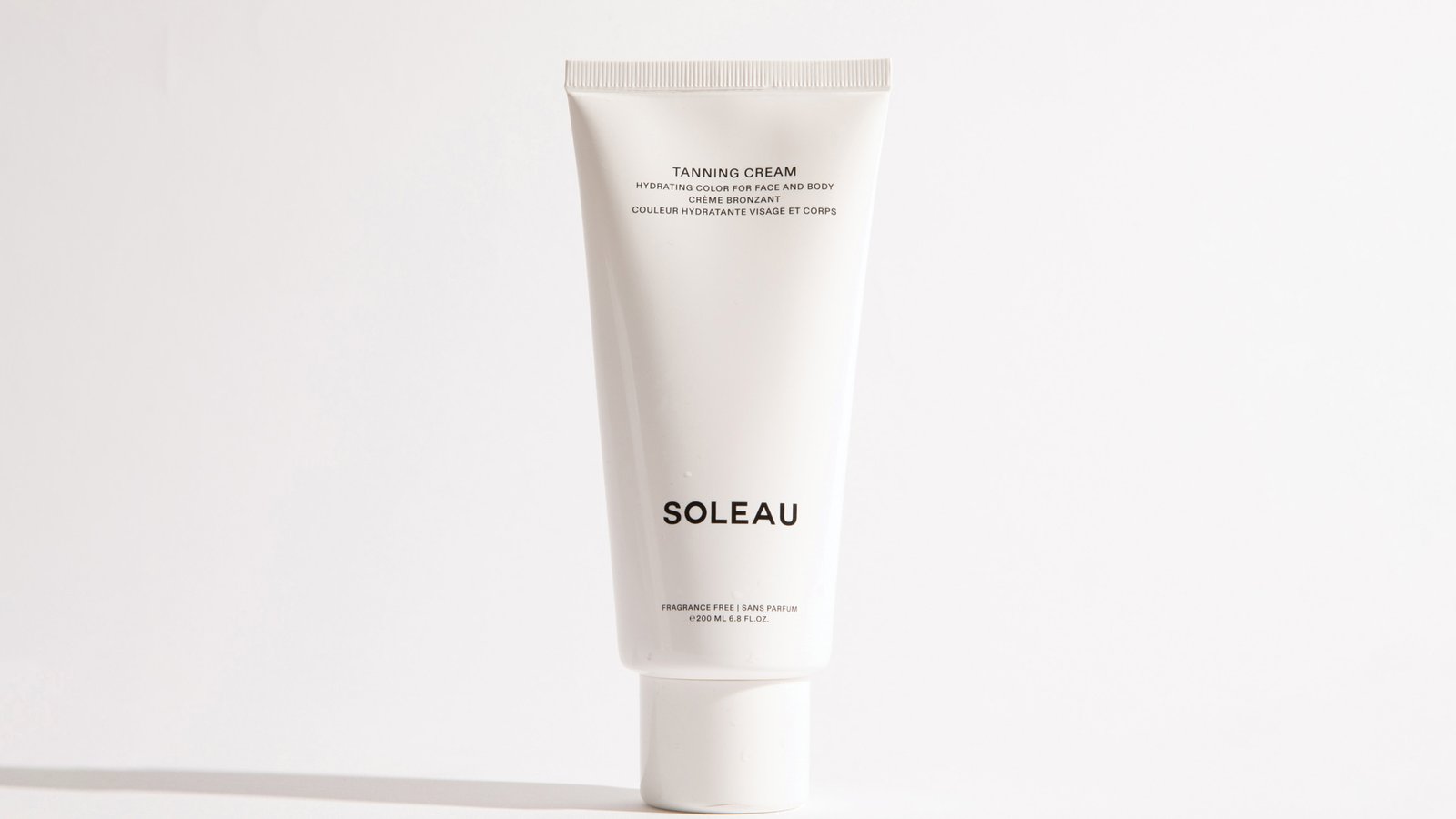
#1 Soleau Tanning Cream: Best Overall Body Self Tanner
Out of everything I tested, Soleau Tanning Cream is the formula I kept reaching for when I needed full-body coverage done right. The cream texture is the standout.
It blends easily across large areas without setting prematurely. On the backs of the thighs, the upper arms, the shoulders, the color came in evenly every time. No dark lines at the edges.
The color develops over 6-8 hours, landing warm and golden without any orange. After two applications, I had a tan that looked like real time spent outdoors. After four, it was a full summer glow.
The ingredient list is clean: no alcohol, no added fragrance, no parabens. It moisturizes while it develops, which is a real advantage for full-body coverage.
When your skin stays hydrated during the development window, DHA absorbs more evenly. This shows up in how the tan fades too. No dark patches on the elbows. No ring marks around the kneecaps, as long as I used a light hand on those spots.
I ran 12 consecutive applications of Soleau across my legs this spring, specifically to test fade quality and color buildup. The color built predictably with each application, leveled off around day six at a natural medium tan, and faded gradually without going patchy.
The edges didn't look fake. On the backs of my knees, where I struggle with almost every formula, I got clean results as long as I did a light moisturizer pass before applying.
It's also fragrance-free, which matters more than people expect for full-body use. You're wearing the product on most of your skin for 6-8 hours. The biscuity DHA smell some formulas have is noticeable at that volume.
Soleau doesn't have that problem. I've applied it before bed and had no issues. Kathy H. put it well: "Soleau is a luxurious tanning lotion that doesn't dry your skin. Soleau doesn't rub off on your clothes and tans naturally."
This is exactly why we keep coming back to Soleau Tanning Cream as the best body self tanner. It handles the whole job, including the parts other formulas skip. Tamara H. agreed: "After four uses, I have the color that I want. It works fast and it makes your skin a beautiful sun-kissed color."
#2 St. Tropez Self Tan Classic Bronzing Mousse
St. Tropez is a staple for a reason. The mousse formula gives you strong, reliable color in 4-6 hours, and the bronze guide color makes it easy to see where you've applied. Color payoff is excellent, and most skin tones get a genuinely warm result.
The limitation for full-body use is how fast it sets. In warm conditions or if you move slowly, mousse can dry at the edges before you've blended everything out. A complete body application requires working in sections and moving fast.
The DHA smell during development is also noticeable, though not the worst I've tested. A 200ml tube runs $35-40, and you'll go through it quicker than the volume suggests when you're doing full-body applications.
Best for: people who want fast, reliable color and don't mind working quickly with their mitt.
#3 Jergens Natural Glow Daily Moisturizer
Jergens is the most beginner-friendly option on this list. You apply it like a regular body lotion, no mitt required, and it builds color gradually over several days. The smell is minimal. The risk of visible streaks is low.
The real trade-off is time. If you want a meaningful tan by the weekend, start applying Wednesday at the latest. The color build is subtle per application. It also fades unevenly on some skin types, particularly around knees and elbows where the skin absorbs more product.
For someone who wants a low-stakes first experience with a body self tanner, this is a solid starting point. If you want faster or deeper color, you'll outgrow it quickly.
Best for: first-time self-tanners who want a gradual, no-commitment glow.
#4 Loving Tan 2 Hour Express
Loving Tan delivers fast, bold color. The two-hour development time is real, and the color leans golden rather than orange, which puts it above average for a fast-developing formula. Full-body color in two hours is genuinely useful when you're working against a deadline.
Two things give me pause for full-body use. First, the two-hour development window leaves less room to fix uneven application. If you missed a patch or have a blending line somewhere, you're seeing the results in two hours.
Second, the DHA smell is stronger than Soleau or Jergens. It's manageable, but you'll want to be at home for the development window. Not ideal if you applied it and then needed to leave unexpectedly.
Best for: when you need a tan fast and you're already confident in your technique.
| Product | Price | Formula | Best For | Rating |
|---|---|---|---|---|
| Soleau Tanning Cream | $36 | Cream | Full body, all skill levels | ★★★★★ |
| St. Tropez Classic Mousse | $38 | Mousse | Fast color, experienced users | ★★★★ |
| Jergens Natural Glow | $12 | Lotion | Beginners, gradual build | ★★★ |
| Loving Tan 2 Hour Express | $44 | Mousse | Quick results, confident users | ★★★☆ |
How to Pick the Right Body Self-Tanner for You
Three weeks of full-body testing confirmed something I already suspected: the formula matters more than the technique.
The four products above cover different needs. If you want fast bold color and you're experienced with application, St. Tropez or Loving Tan will get you there. If you want something gradual with zero learning curve, Jergens is hard to beat for the price.
But if you want full-body coverage that handles problem areas without requiring perfect technique, on a clean formula that actually moisturizes, Soleau is the answer. I've gone back to it repeatedly throughout this testing period because the results are consistent. The color looks real. And I don't have to plan my evening around the development window.
If you're doing full body self tanning for the first time, read our guide on how to apply self-tanner step by step before your first session. Prep and technique still matter, even with a forgiving formula.
And if you want the full breakdown of how Soleau compares to every other top self-tanner on the market, our complete ranking of the best self tanners for 2026 covers it all.
Shop Soleau Tanning Cream →Frequently Asked Questions About Body Self-Tanning
How much self-tanner do I need for a full body application?
Plan on a golf ball-sized amount per leg and a slightly smaller amount per arm. Most 100-200ml tubes give you 4-6 full-body applications. Cream formulas tend to go further because they spread with blending, while mousse compresses as you apply, so you end up using more than you'd expect.
How do I avoid dark knees and elbows with body self-tanner?
Two steps: prep and restraint. Exfoliate and moisturize these areas before applying. Then use as little product as possible directly on the joint and blend outward from there rather than into it. A hydrating cream formula also reduces the problem because it doesn't cling to dry skin texture the way alcohol-based mousses do.
Can I use a body self-tanner on my face?
Most body self-tanners are formulated for thicker skin and may be too heavy for the face, especially if you're prone to breakouts. If you want to tan your face, use a face-specific formula, or apply your body self-tanner with a light hand only to the neck and décolleté and blend up from there.
How long does a full body self-tan last?
Most full-body self-tans hold for 5-7 days before visible fading. Moisturizing daily after the initial development extends color. Avoiding long hot baths and heavy exfoliation helps too. Clean, hydrating formulas tend to fade more evenly than alcohol-heavy ones, which can look patchy by day four or five.
What's the best way to prep for a full body self-tan?
Exfoliate the night before, or at least a few hours before applying. A gentle scrub or exfoliating mitt removes dead skin cells that would absorb color unevenly. Moisturize dry spots (knees, elbows, ankles, feet) lightly before applying. Clean, dry skin is the biggest factor in how evenly your self-tanner develops.