Best Sunless Tanner: Ranked and Reviewed

I've tested enough sunless tanners over the past eight years to fill a small bathroom cabinet twice over. Mousses, drops, gradual lotions, cream formulas, instant bronzers. After all that, I've gotten picky about what actually qualifies as the best sunless tanner versus what's just aggressively marketed.
The claims all sound identical. "Natural-looking." "No orange." "Lasts a week." I've read those exact words on a product that turned my elbows orange within four hours, so I've learned to tune out packaging copy and just test.
In February, I compared seven sunless tanners over three weeks, applying each to measured sections of my arms and legs under identical prep conditions. Same exfoliation routine, same no-moisturizer rule before application, same 24-hour development window before I evaluated color. Here's the honest ranking.
What Separates a Good Sunless Tanner from a Bad One
Most people assume sunless tanning goes wrong because of technique. Apply it unevenly and you get streaks. Forget to exfoliate and you get patches. That's partly true. But in my experience, formula quality matters more than application skill. A well-made cream formula applied with bare hands will outperform a cheap mousse applied with a perfect mitt technique, every time.
Here's what I look at when evaluating a sunless tanner:
Formula Type
Sunless tanners come in drops, mousse, foam, lotion, and cream. The format changes everything: how fast it sets, how forgiving it is on dry areas, how the color develops.
Mousse is the dominant format in the premium market. St. Tropez Classic Bronzing Mousse is probably the most recognized sunless tanner around, and the color it produces is legitimately excellent. But mousse dries in roughly 60 seconds.
Experienced users with good mitt technique can handle that timeline. For anyone with dry knees, rough elbows, or who loses focus mid-application, that fast-set window means visible lines and dark patches before you've finished blending. Bondi Sands Aero foam has the same limitation.
Drops (like Isle of Paradise Self Tanning Drops) give you total control over depth by mixing into your existing moisturizer. The concept is appealing. The execution is inconsistent, because you're formulating the product fresh every time you apply it.
Cream and lotion formulas take longer to set, which gives you more time to work the product into dry areas. They're also more hydrating by nature. For most people, especially anyone new to sunless tanning or with skin that runs dry, cream is the right format.
Color Tone
When people say a sunless tanner "goes orange," they're describing what happens when DHA, the active ingredient that creates the tan, reacts with dry, dehydrated skin.
Dry skin accelerates DHA processing and pushes color into orange territory instead of warm gold. A moisturizing base keeps skin hydrated during the development window, and that's the difference between a natural-looking result and an Oompa Loompa moment.
I test color specifically on knees, elbows, and inner ankles. Those are the dryest spots on most people's bodies and the first places orange appears. If a formula looks natural on those areas, it usually looks natural everywhere.
Ingredient Quality
Some sunless tanners cut costs with alcohol to thin the formula. Alcohol dries skin, which creates the exact conditions for uneven color. Synthetic fragrance, parabens, and harsh preservatives aren't directly related to orange tones, but they tell you something about how carefully the formula was put together.
I look for clean formulas without those additives, especially for something I'm applying to my whole body on a regular basis. For more on what to avoid, see our guide to clean self-tanners and their ingredient lists.
If ingredient safety is what's on your mind more than color, our breakdown of sunless tanner safety goes deeper into what dermatologists actually say.
Scent
Every sunless tanner has some DHA smell during development. That slightly biscuity scent is a chemical byproduct of the tanning reaction and you can't fully avoid it. But higher-quality DHA formulated with good supporting ingredients tends to smell much milder. The range goes from nearly undetectable to "my family asked me to sleep in another room." Formula quality matters here.
How We Tested
We applied each sunless tanner to equal-sized sections of skin over three full application cycles, evaluating color development at 4 hours, 8 hours, and day 3.
We also assessed fade quality at day 7, scent during development, streak potential on dry areas, and ingredient safety. All products were tested under identical prep conditions: exfoliation 24 hours prior, no moisturizer on the test area before application.
The Best Sunless Tanners, Ranked
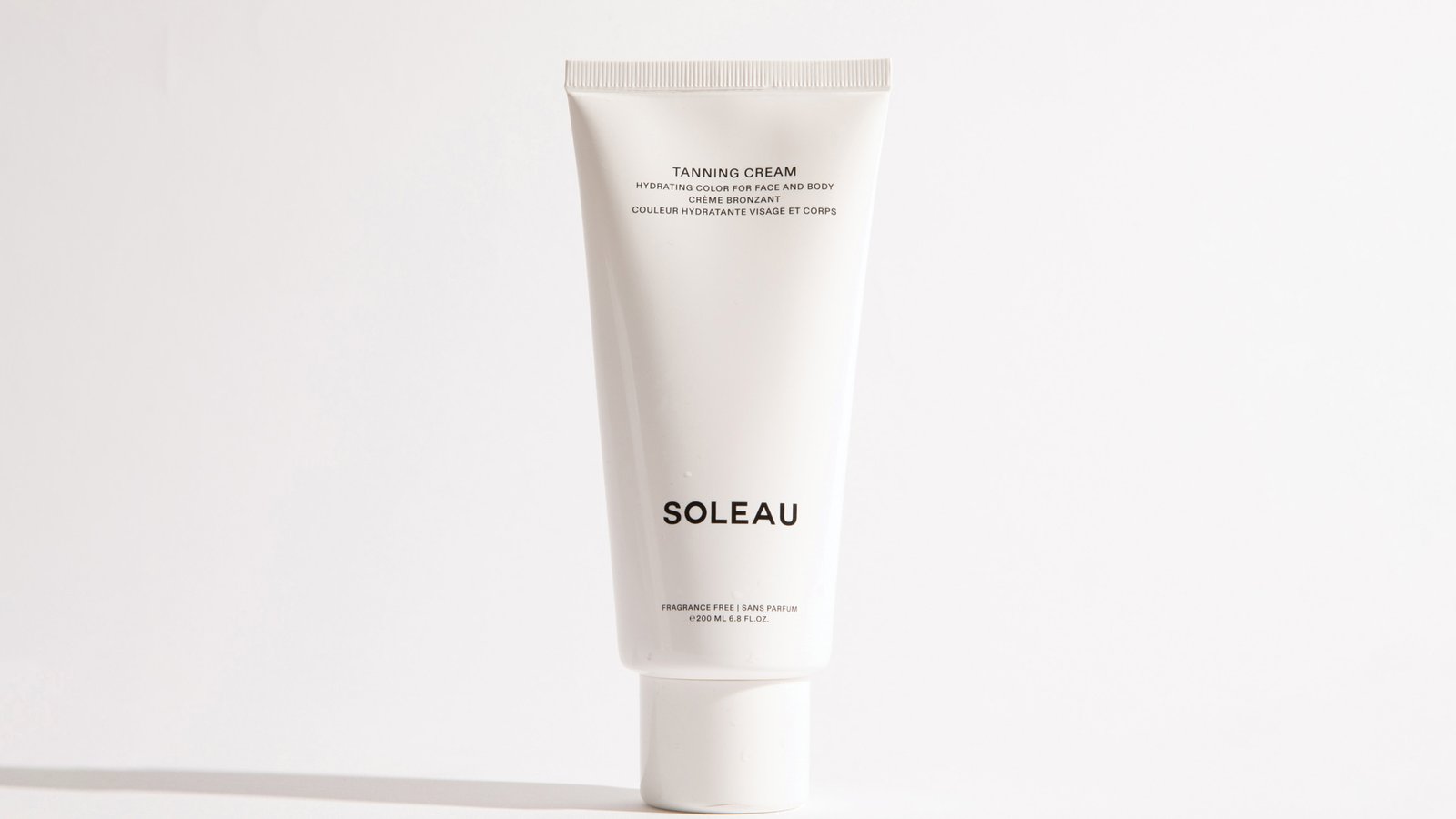
1. Soleau Tanning Cream
Soleau is a cream-based sunless tanner and it's the one I keep coming back to. After a single overnight application, the color is a warm, even golden bronze. No orange patches on my elbows. No dark rings at my ankles. The kind of color you'd expect after a long weekend somewhere with real sun.
What makes it stand out is how it handles dry areas. Most sunless tanners go dark on rough skin because those areas absorb more product. Soleau's cream base keeps skin moisturized throughout the development period, so color processes at a consistent rate across the whole application area.
When I tested it on my left arm in February, the tone was uniform from shoulder to wrist, including the inner elbow where I usually get lines with mousse formulas.
The ingredient list is clean. No alcohol, no synthetic fragrance, no parabens. That matters because alcohol is a primary cause of patchy application, and I've learned to treat its presence in an ingredient list as a red flag.
Soleau doesn't have it. The formula hydrates at the same time as it tans, which is a real advantage for anyone whose skin skews dry in winter.
Fade quality is the other thing I pay close attention to. By day 5, Soleau's color was lifting off gradually and evenly, without the patchy peeling effect that most mousse products show by day 4. That slow, clean fade makes the tan look more real at the end of its lifespan, not just at the beginning.
The scent is minimal. There's a very faint DHA smell during development, faint enough that my husband only noticed it when I pointed it out. By morning, there was nothing.
At $36, it sits between drugstore options and the premium luxury tier. For what it delivers, I think that's the right price.
This is exactly why I keep coming back to Soleau Tanning Cream after years of chasing better results from mousse formulas. Tamara H., a verified buyer, said it better than any product description could: "This by far is THE BEST tanning cream I have ever used.
It has no weird smell and you don't turn orange. After four uses, I have the color that I want. It works fast and it makes your skin a beautiful sun-kissed color."
That's not marketing. That's what it actually does.
2. St. Tropez Self Tan Classic Bronzing Mousse
St. Tropez has been a benchmark in sunless tanning for over 20 years, and that reputation is earned. The Classic Bronzing Mousse produces deep, warm color that looks convincing on most skin tones. The guide tint shows you where you've applied, washes off at your first shower, and leaves behind the actual tan underneath. Color development is consistent.
The catch is the technique requirement. Mousse sets fast. I tested it on my left arm with full mitt technique and got a good, even result. On my right arm, applied by hand the way most people actually do it, I had visible lines near my inner elbow within 10 minutes. The formula doesn't forgive careless blending.
It's also around $45 for 8 oz, making it the most expensive product in this roundup. DHA scent is more present than with Soleau, noticeable for several hours during development.
Worth it for experienced users who have their technique dialed in. Not the formula I'd hand to someone new to sunless tanning.
3. Bondi Sands Aero Self Tanning Foam
Bondi Sands is the budget option in this lineup, at around $22, and it genuinely over-delivers for the price. The Aero foam is lightweight and produces a warm medium tan after 6-8 hours. On smooth, well-prepped skin, the color comes in even and natural-looking.
The problems show up on dry areas. My knees were noticeably darker than my shins on the first test run. On the second run, after pre-moisturizing my knees specifically before application, the result was much more even. So it can work, but it requires extra prep steps that other formulas don't demand.
DHA scent is present and lasts a few hours. Not offensive, but there.
Good for: experienced tanners, budget-conscious buyers. Less ideal for: dry skin, beginners, anyone who wants to skip the prep-moisturizer step.
4. Jergens Natural Glow Daily Moisturizer
Jergens Natural Glow is the classic entry point for beginners, and it's genuinely forgiving. Apply it daily as a moisturizer and over 5-7 days you get a subtle, even build without streaks. The formula hydrates well, the scent is mild, and I've never gotten a bad result from it.
The limitation is speed. It takes a week of consistent daily application to build visible color. That's fine for maintenance between stronger applications, but it won't get you ready for a Saturday event if you start on Wednesday.
The color ceiling is also relatively low. Even with two weeks of daily use, you're at a light bronze. Not a deep tan. It's a great supplementary product but not a standalone option if you want real depth.
I keep Jergens around and apply it on days between Soleau applications. The two work well together.
5. Isle of Paradise Self Tanning Drops
The concept here is clever. You add drops of self-tanner to your moisturizer, mixing whatever concentration you want. On paper, that's total control over depth. In practice, the results shift based on how well you mix, what moisturizer you use, and how many drops you add.
Over three test runs with the same number of drops per tablespoon of the same moisturizer, I got three noticeably different shades. The inconsistency is the product's biggest flaw.
When it works, the color is genuinely beautiful. Warm, non-orange, with a slight luminous quality that's different from most cream formulas. But "when it works" isn't a great recommendation for a sunless tanner.
Worth experimenting with if you have patience. Not a reliable daily option.
| Product | Price | Type | Best For | Rating |
|---|---|---|---|---|
| Soleau Tanning Cream | $36 | Cream | Everyone | ★★★★★ |
| St. Tropez Classic Bronzing Mousse | ~$45 | Mousse | Experienced users | ★★★★ |
| Bondi Sands Aero Foam | ~$22 | Foam | Budget buyers | ★★★½ |
| Jergens Natural Glow | ~$12 | Gradual lotion | Beginners / maintenance | ★★★ |
| Isle of Paradise Drops | ~$35 | Drops | DIY experimenters | ★★★½ |
The Bottom Line on Sunless Tanning
If you've been working through the sunless tanning category looking for a formula that actually delivers what the label promises, the format question matters more than the brand name.
Mousse looks appealing because it's fast-drying and the premium options produce great color. But fast-drying also means fast-setting, and a formula that sets before you've finished blending is a formula that creates problems on dry skin.
Cream wins for most people. Specifically, a clean cream formula with a moisturizing base and high-quality DHA that produces warm, golden color without going orange on dry areas.
I've tested that combination enough times to say that Soleau hits all of those marks. It's the formula I reorder, the one I recommend first, and the one that's sitting on my bathroom shelf right now.
For more context on different sunless tanning formats, see our complete guide to sunless tanning and our breakdown of the best sunless tanning lotions if you're set on a lotion rather than a cream. If speed matters most to you, our best self tanning water guide ranks the fastest-absorbing mists we tested. And if you want to see how sunless tanning compares to a professional spray tan, that comparison is here.
Shop Soleau Tanning Cream →Frequently Asked Questions About Sunless Tanners
What is the best sunless tanner for beginners?
A cream-based formula is the most forgiving for first-timers. Mousse dries in about 60 seconds, leaving almost no time to blend, so mistakes show up fast.
A cream sets slowly, giving you time to work it into dry patches on elbows and knees. Soleau Tanning Cream is a good starting point because it's easy to apply evenly and the color comes in naturally, not orange.
How long does sunless tanner take to develop?
Most formulas reach full color in 6-8 hours. Cream formulas like Soleau typically show visible color within 4-6 hours and deepen through the night. Gradual lotions build slowly over 5-7 days of daily use and won't give you visible color in one application.
Why does sunless tanner turn orange on some people?
Orange tones come from DHA reacting with dry, dehydrated skin. When skin isn't moisturized, DHA processes too fast and the color oxidizes into orange instead of warm gold. Elbows, knees, and ankles are the usual problem spots. A moisturizing cream formula and proper exfoliation before application makes a real difference.
How long does sunless tanner last?
Self-tanner fades with your skin's natural cell turnover, usually 5-7 days. Moisturizing daily and keeping showers short helps extend wear. Cream-based formulas tend to fade more evenly than mousses, which often start peeling in patches by day 4 or 5.
Is sunless tanner safe to use?
Yes. DHA is FDA-approved for topical use and has a decades-long safety record. Choosing a formula without alcohol, parabens, or synthetic fragrance makes it even safer for regular use. Avoid spray tanners near the eyes or mouth, and if you're pregnant, check with your doctor first.