Self Tanner Ingredients: What to Look For and Avoid

For years I grabbed self-tanners without reading a single label. I just sniffed the cap, looked for something that promised "natural" on the front, and hoped for the best.
Then I developed a red, itchy rash on my left arm after trying a drugstore brand I'd never used before. I spent two days assuming I'd burned myself somehow. Turns out it was an artificial fragrance ingredient, right there in the list if I'd ever thought to look.
Self tanner ingredients matter more than the marketing does. They determine whether your color comes in golden or orange, whether it fades smoothly or turns patchy, and whether you'll smell like a warm cookie for 10 hours or barely notice anything at all.
After 8 years testing products and reporting on what actually works, here's what I've learned about which ingredients to seek out and which ones to skip.
The One Ingredient That Does All the Work: DHA
Every self-tanner that actually tans relies on DHA. Dihydroxyacetone is a colorless sugar compound that reacts with amino acids in the dead cells on the surface of your skin, creating a brown color through a reaction called the Maillard reaction. No UV light involved. No damage to the living layers underneath.
The reaction typically takes 4-8 hours to fully develop, which is why products tell you to wait before showering. DHA concentration in self-tanners usually runs from about 3% in light gradual formulas up to around 10% in intense, fast-acting products. That range matters a lot, and I'll get into it below.
If you'd rather set your own concentration instead of trusting a bottle's fixed formula, our complete guide to tanning drops covers how mixing DHA serum into your own moisturizer gives you that control.
One thing worth knowing: DHA is responsible for that signature biscuity smell you've probably noticed on cheaper tanners. It's not a sign of low-quality ingredients on its own. DHA just oxidizes that way on your skin.
But formulas with fewer additional chemicals tend to smell significantly less during development, because there's nothing amplifying or clashing with the base scent. If you're shopping specifically for low-odor self tanner chemicals, look at the full ingredient list rather than just trusting "light scent" on the label.
How DHA Concentration Affects Your Result
Lower DHA (3-5%) gives you a subtle, buildable glow. It's forgiving, easier to control, and works better on fair skin that wants to ease in gradually. Higher DHA (7-10%) develops faster and deeper but leaves very little margin for error. Apply unevenly with a high-concentration formula and you'll see every streak clearly by morning.
For most people, a mid-range formula somewhere around 5-7% DHA gives the best results: enough color to be noticeable, slow enough to be manageable. I spent three weeks testing a high-DHA mousse on one arm and a mid-range cream on the other, and the cream arm looked better every single time. More even, better fade. The mousse was dramatic.
Self Tanner Ingredients to Avoid
Alcohol (SD Alcohol or Alcohol Denat)
Lots of mousse and spray formulas use alcohol as a fast-drying agent. It works, but it strips moisture from your skin while the DHA is developing. Dry skin fades patchier and faster. Areas that tend to dry out faster, like knees, elbows, and ankles, get hit the hardest.
I tested an alcohol-heavy mousse one summer and by day four my knees were almost completely faded while the rest of my legs still looked great. The effect looked ridiculous.
Switching to an alcohol-free cream formula fixed that problem completely. If you've been blaming your skin for patchy fades, check whether your product has SD alcohol near the top of the list.
Artificial Fragrance
"Fragrance" on a cosmetic label can represent dozens of different undisclosed chemicals. Brands aren't required to list individual fragrance components, so there's no way to know what you're getting. For reactive skin, artificial fragrance is the most common trigger for contact dermatitis. That was the culprit in my arm rash situation.
But even if your skin tolerates fragrance fine, it tends to compete with the DHA smell in weird ways. The result is sometimes worse than unscented. Look for "fragrance-free" specifically. "Unscented" is not the same thing. Unscented means they've added a masking fragrance to cover the base smell, which is the opposite of what you want.
Parabens
Parabens (methylparaben, propylparaben, butylparaben) are preservatives. They keep products shelf-stable, which is fine in theory, but they've been flagged in studies for potential hormone disruption, and many people with sensitive or acne-prone skin find that paraben-heavy formulas cause breakouts. Clean formulas use alternatives like phenoxyethanol or rely on more stable plant-based preservatives.
This isn't about being alarmist. Small amounts of parabens probably aren't catastrophic for most people. But if you're already comparing two products and one has them and one doesn't, skip the ones that do. There's no benefit to including them for you as the consumer.
Mineral Oil and Heavy Silicones
Mineral oil forms a film on your skin that can interfere with how well DHA penetrates the top cell layer. You'll notice color coming in spottier than expected, especially over dry patches. Some well-known budget brands, including Jergens Natural Glow, use mineral oil in the formula.
Jergens works fine for a very casual, low-commitment tan, but don't expect a consistent or long-lasting result from it. It's a moisturizer that adds a little color, not a serious self-tanner.
Heavy silicones (dimethicone especially) can have a similar issue. They're not terrible in small amounts, but they're a sign of a formula that prioritizes a certain slip and texture over actual tanning performance.
Self Tanner Ingredients Worth Seeking Out
Aloe Vera, Glycerin, and Shea Butter
These make a bigger difference than people expect. A hydrating base keeps skin supple while DHA is working, which means more consistent coverage and a smoother, more gradual fade.
Aloe vera is soothing and helps calm any mild irritation from the DHA reaction itself. Glycerin pulls moisture into the skin, which helps color develop evenly instead of settling into dry patches.
St. Tropez's Classic Bronzing Mousse uses a good aloe base, which is partly why it's been a go-to for so long despite the price. The hydrating formula genuinely contributes to why the tan looks natural rather than patchy. Loving Tan does something similar. You pay more for these products, but part of what you're paying for is ingredient quality.
Erythrulose
Erythrulose is a second sugar compound, similar to DHA but slower-acting. On its own it creates a lighter, honey-toned color. Combined with DHA, it produces more depth and fades more evenly, because the two compounds develop and break down at different rates. The result is less of that sudden fade-to-nothing that happens with DHA-only formulas.
Our full breakdown of erythrulose gets into exactly how it compares to DHA and why so many formulas use both.
Bondi Sands uses a DHA and erythrulose blend in several of their products, which is one reason their tans tend to look natural across a wider range of skin tones. Isle of Paradise also includes it. When you see both listed, it's a good sign the formula was designed with color quality in mind rather than just speed.
Vitamin E (Tocopherol) and Plant Extracts
Vitamin E is an antioxidant that helps neutralize free radicals produced during the DHA-skin reaction. It's not just a marketing add-in. It actually helps your skin look healthier after the tanning process, not just during it.
Rosemary extract and green tea extract work similarly. They also function as natural preservatives, which means formulas with them tend to stay stable without needing as many synthetic additives.
These are the kinds of what's in self tanner that make a formula genuinely good for your skin, not just on it.
How to Actually Read a Self-Tanner Label
Ingredients are listed in descending order of concentration. The first five ingredients make up most of the formula. If "SD Alcohol" or "Alcohol Denat" is in the top five, it's a drying formula. If "Fragrance" is anywhere in the list, it's not fragrance-free, period.
DHA should appear in the top half of the list, usually somewhere between position 3 and 8. If it's buried near the bottom, the formula is too diluted to do much. That's how some moisturizers with a "subtle tint" are sold as self-tanners without actually being ones.
Look for recognizable base ingredients near the top: water, aloe barbadensis (aloe vera), glycerin. Those tell you the formula is built around hydration rather than texture agents or alcohol. A clean self-tanner ingredient list shouldn't read like a chemistry exam. If you can recognize most of what's there, that's a good sign.
I check every new product against three questions: Is DHA high enough on the list to actually work? Is fragrance absent? Are there any alcohol or mineral oil ingredients near the top? If it passes all three, it usually performs well. If it fails any of them, I know what to expect.
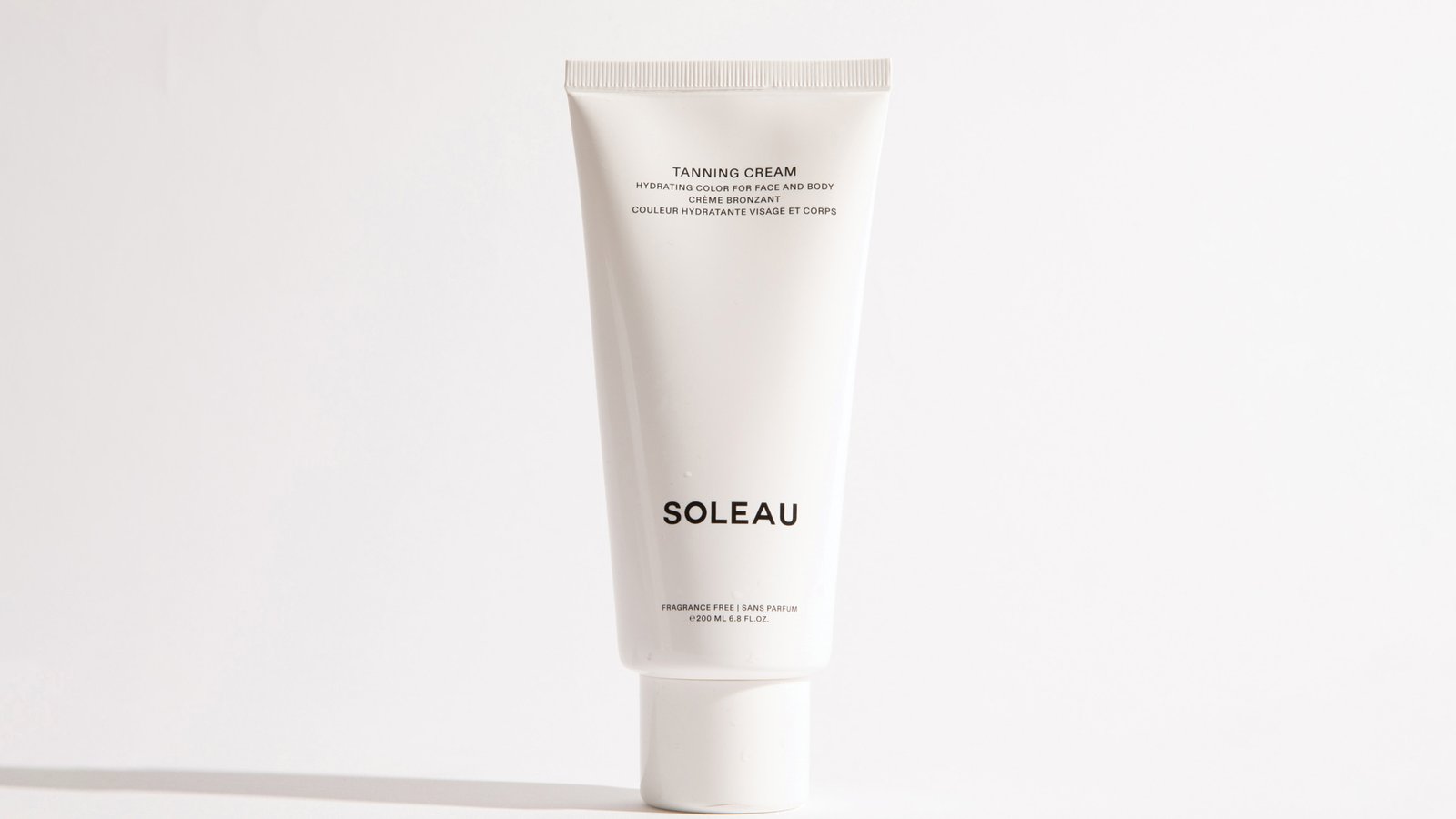
This is exactly why we keep coming back to Soleau Tanning Cream. It passes every one of those checks: the DHA concentration is in the effective mid-range, there's no fragrance added, no alcohol, no parabens.
The base is built around hydrating ingredients that actually nourish your skin while the color develops. Tena H. said it better than I could after her first bottle: "Clean ingredients and no smell. It is also hydrating and goes on like a lotion." That's the whole thing, right there.
Why Clean Self-Tanner Ingredients Actually Matter for Your Results
There's a tendency to treat clean beauty as a separate concern from performance. Like you're either choosing something effective or something safe. With self-tanners, that's not really true. The problematic ingredients (alcohol, mineral oil, fragrance) don't just raise health questions. They actively make the product work worse.
Alcohol dries out your skin and causes patchy fades. Mineral oil blocks even DHA penetration. Artificial fragrance is the most common trigger for skin reactions. Skipping them isn't just about being cautious with DHA self tanner chemicals. It genuinely produces better color.
The brands that figured this out, whether intentionally or because they were building a clean formula from the start, ended up with products that perform better across more skin types. St. Tropez figured it out years ago. Soleau built their formula that way from day one. The connection between clean ingredients and good results isn't a coincidence.
If you want to go deeper on specific ingredients to watch for and why, our guide to non-toxic self-tanners walks through the full list of chemicals the clean beauty community flags and why.
And if you've been experiencing reactions or uneven results, our piece on self-tanner for sensitive skin covers which ingredients are most likely responsible and how to work around them.
For a full breakdown of which products actually deliver on a clean formula, our best clean self-tanner roundup ranks the top options with ingredient analysis included.
Shop Soleau Tanning Cream →Frequently Asked Questions About Self-Tanner Ingredients
What is DHA in self tanner and is it safe?
DHA (dihydroxyacetone) is a colorless sugar compound that reacts with amino acids in the top layer of dead skin cells to produce a brown color. It's considered safe by dermatologists and the FDA for topical use. It doesn't penetrate into living skin cells or affect your body internally. The concentration matters more than the presence of DHA itself.
Why does self tanner smell bad?
The biscuity smell comes from DHA oxidizing on your skin during color development. Formulas with added artificial fragrance often smell worse, not better, because the scents mix unpredictably with the DHA reaction. Fragrance-free formulas with fewer chemical additives tend to have noticeably less odor during development. Clean ingredient lists and low smell are usually connected.
Can self tanner ingredients cause a rash or skin reaction?
Yes. The most common triggers are artificial fragrance, SD alcohol, and parabens. DHA itself can occasionally irritate very reactive skin at high concentrations, but it's usually one of the additives causing the problem. If you've had a reaction, check the ingredient list for those three categories first. Switching to a fragrance-free, alcohol-free formula resolves it in most cases.
What makes a self tanner "clean"?
A clean self-tanner avoids artificial fragrance, parabens, mineral oil, phthalates, and unnecessary chemical fillers. Clean formulas rely on plant-derived ingredients, natural preservatives, and hydrating bases like aloe vera or shea butter. The term isn't regulated, so you have to look at the actual label rather than trusting marketing claims.
Does a higher DHA percentage mean a better tan?
Not necessarily. Higher DHA (7-10%) develops faster and deeper but leaves less margin for application mistakes. Most people get the best results from a mid-range formula around 5-7% DHA. Fair skin types especially tend to do better with lower concentrations to avoid going too dark or picking up orange undertones.