How to Self Tan Your Face Without Breaking Out

Your face is not the same as the rest of your body. Not in a pep-talk way. Biologically, your face has more oil glands per square inch than almost anywhere else on you, thinner skin, and tissue that's more reactive to almost everything. The self-tanner that works perfectly on your legs isn't automatically going to behave on your cheeks.
I learned this during a vacation prep week where I spread the same thick mousse I'd been using on my body straight across my face. Three days later I had small bumps forming along my jawline.
Not a disaster. But annoying enough that I started paying attention to what actually happens when you self tan your face, and what you need to do differently to get it right.
After two years of testing this specifically, on my own face, across a dozen different formulas, here's what I know.
Why Your Face Needs a Different Approach
Your face produces roughly four to five times more oil than your legs or arms. That oil is part of what keeps facial skin looking healthy, but it also means the pores on your face are more active and more susceptible to blockage from heavy ingredients.
Face skin is also thinner than body skin. DHA, the active ingredient in every self-tanner, works by reacting with amino acids in the outermost layer of your skin. On a thinner surface, that reaction happens faster and can go darker than you'd expect from the same product at the same amount.
Then there's the washing factor. You cleanse your face twice a day. That frequent cleansing accelerates cell turnover, which means a face tan fades faster than a body tan.
Most people find their face color lasts 3-4 days compared to the 5-7 days they get on their body. Worth knowing before you apply, so you're not surprised by how quickly you need to reapply.
This is why a body formula on your face often leads to patchy, clogged, or over-dark results. The formula matters more for face self tanning than for any other body area.
For the full picture on formats, ingredients, and which face-specific products actually work, see our complete guide to self tanner for face.
What Makes a Self Tanner Face-Safe
This is the part most self-tanning guides skip over. They tell you to exfoliate and apply with a mitt and call it a day. But if your formula contains the wrong ingredients, none of that technique work matters much.
Non-Comedogenic Ingredients
The comedogenicity scale rates ingredients from 0 (non-comedogenic) to 5 (highly pore-clogging). Coconut oil, a popular moisturizer, rates a 4. Isopropyl myristate, a texture agent that shows up in plenty of body formulas, rates a 5. Both feel good on skin and spread easily. Both have no business going on your face if you're prone to congestion.
For face use, look for lighter carriers instead: jojoba oil rates a 2, caprylic/capric triglycerides rates 1-2, squalane rates a 1. Humectants like glycerin and hyaluronic acid work well too. These hold moisture and help DHA distribute without blocking anything.
No Alcohol
Denatured alcohol (listed as "alcohol denat." on ingredient labels) makes products dry down fast. That's useful in a body mousse when you're trying to get dressed.
On your face, it strips the moisture barrier, which prompts your oil glands to produce more oil to compensate. The surface feels tight and dry. Underneath, the pores are working harder. That cycle doesn't end well for anyone's skin.
Check where alcohol appears on the list. If it's in the first third of the ingredients, there's a meaningful amount of it in the formula.
Fragrance-Free
Most self-tanners contain added fragrance to cover the faint biscuity DHA smell that develops as the product reacts with your skin. Fragrance is one of the most common skin sensitizers, and facial skin reacts to it more than body skin does. Redness, minor irritation, and sensitization over time are all possible with repeated fragrance exposure on your face.
Fragrance-free formulas do have a faint smell during the development window. That's just the DHA doing its job. It's temporary, and it's a much better trade-off than ongoing irritation. Our guide to the best clean self tanners covers more on why fragrance-free matters for skin health in general.
Lower DHA Concentration
A body formula designed for a deep tan, applied at body-thickness to your face, will look darker and more orange-leaning than you intended.
Either choose a gradual or light-coverage formula for face use, or dilute a standard formula by mixing it 2:1 with your regular moisturizer before applying. I do the second thing every time. The color builds over two or three applications and looks far more believable than one heavy coat.
How to Prep Your Face for Self-Tanner
Patchy face tans are almost always a prep problem. Not a product problem, not a technique problem. Prep.
Exfoliate two days before, not the night before. Right after exfoliation, your skin surface is freshly exposed and absorbs DHA faster and more unevenly. Give it at least 24 hours to settle. I use a light acid toner with lactic acid or mandelic acid the night before application. That's it. Nothing more aggressive.
Pre-moisturize the dry zones. Your hairline, the sides of your nose, your chin. These spots run drier than your cheeks and will grab DHA faster if you don't address them.
A thin layer of plain moisturizer on just those areas before applying tanner keeps everything even. Don't coat your whole face in moisturizer first, though. That creates a barrier that slows down the reaction across the board.
Wash your face and wait. Remove everything before applying: makeup, sunscreen, evening skincare. Self-tanner can't properly react with skin that's coated in something else. Wash, pat dry, and give it 15-20 minutes before you apply.
Skip actives the night before. Retinol, vitamin C, AHAs, prescription treatments. These weaken the top layer of skin and can cause color to develop unevenly or too intensely. Take one night off. If you're on a nightly retinoid, give your skin two nights off before tanning your face.
How to Apply Self Tanner to Your Face
Less is more here. More than anywhere else on your body.
Use your fingertips, not a mitt. The curves of your face, around your nose, near your temples, along the edges of your lips, need a precision that a tanning mitt can't give you. Your fingertips let you feel exactly where you're applying. Wash your hands thoroughly right after.
Start with a pea-sized amount for your entire face if you're using a cream formula. That sounds like almost nothing. It's probably the right amount. You're not trying to achieve a full tan in one session. Two lighter applications a few days apart look more real than one dark layer that goes uneven by the second day.
Work from the center outward. I start at the bridge of my nose and blend upward across my forehead, then outward across my cheeks toward my ears, then down to my jaw and neck.
This mirrors how a real tan develops: the nose, forehead, and cheekbones catch the most sun. Lighter at the edges looks natural. Heavier at the edges looks applied.
The spots that need extra care:
- Hairline: Self-tanner can stain the strands at your hairline. Work product right up to the skin but don't let it sit in the hair. A slightly damp fingertip along the hairline right after application picks up any excess.
- Eyebrows: They absorb DHA well and go dark quickly. Keep product away from your brows entirely, or use a clean cotton swab to lift any that got on them before it has time to develop.
- Eyelids: Skip them entirely.
- Lip area: A small amount on the skin surrounding your lips is fine. Nothing on the lips themselves.
Wait at least 6-8 hours before washing your face. I apply at night, about 10-15 minutes after my skincare routine has fully absorbed, and rinse in the morning.
That window gives the DHA time to complete the reaction. Don't sweat heavily, don't press a pillowcase directly into your face. The night you apply is a back-sleeping night if you can manage it.
And blend down your neck. If you're tanning your face, blend down your neck and across your collarbone. A tanned face sitting on a pale neck is one of the most immediately obvious signs that something was applied from a bottle.
Use the same product, the same dilution, and work the color down toward your chest. For a full step-by-step breakdown across the whole body, our guide on how to apply self-tanner covers everything.
The Formula That Gets It Right
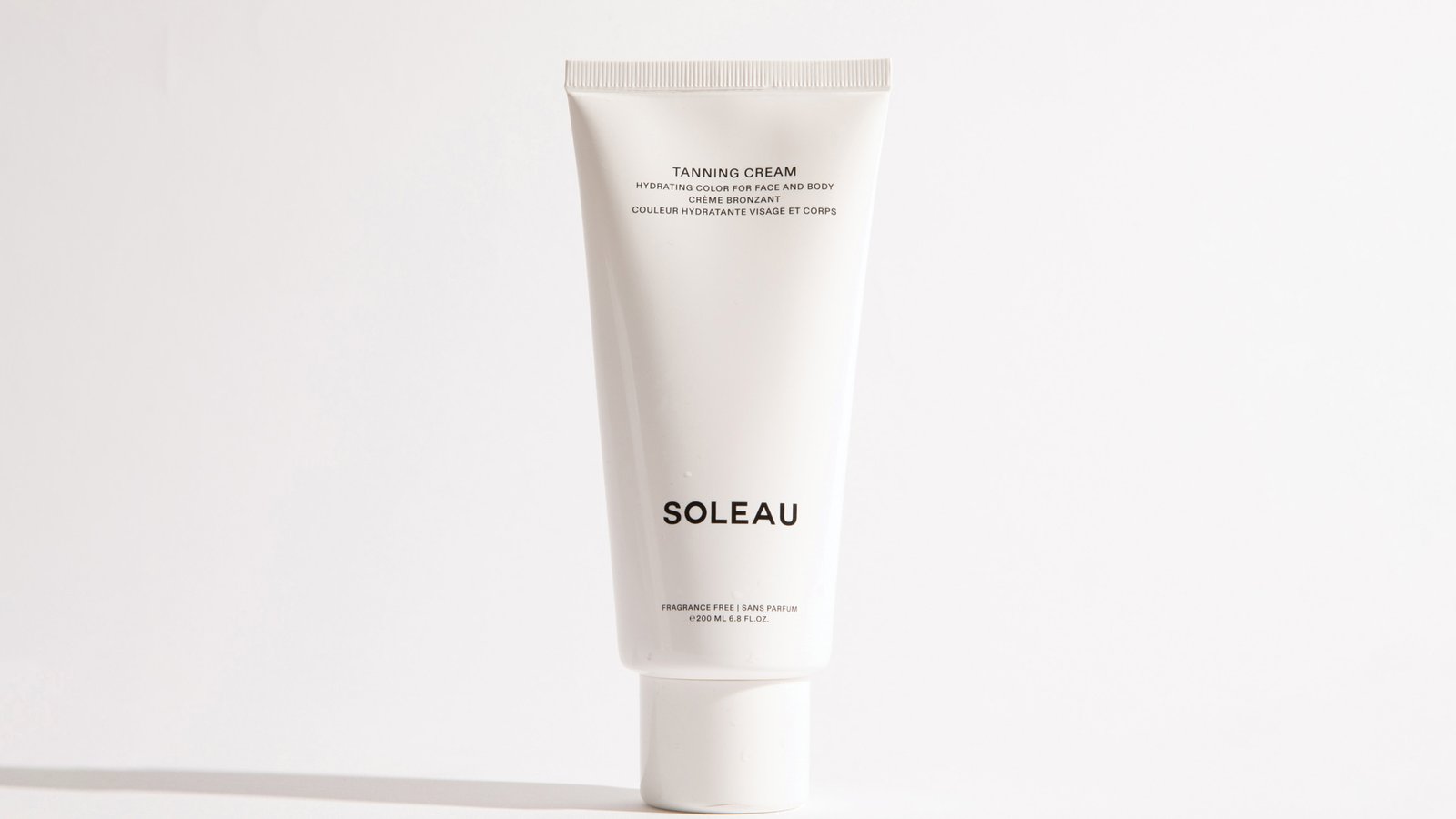
Every criterion I just laid out, non-comedogenic ingredients, no alcohol, no fragrance, a cream texture light enough to dilute with moisturizer, is what I was searching for when I switched to Soleau Tanning Cream for my face. It checks each of those boxes without compromising on color.
The formula is clean and lightweight. No fragrance. No heavy pore-clogging agents. The cream texture blends easily with my regular moisturizer, which lets me control exactly how much color I'm building. I started using it on my face about eighteen months ago and haven't reached for anything else since.
Lauren A., a verified buyer, said it as plainly as possible: "Looks natural, has no smell and does not clog pores. I've tried others that clog pores which makes you sweat."
That's the whole reason I keep coming back to it for face use. It's what a face self tanner should be.
How to Keep Your Face Tan Looking Good
Face tans are higher maintenance than body tans. You wash your face more, treat it more, cleanse it twice a day. The color turns over faster.
Use a mild cleanser while a tan is active. Not an exfoliating wash, not a scrub. Save those for your reapplication prep. A cream or gel cleanser that doesn't strip your skin keeps the color intact longer. I switched to a simple balm cleanser for the days my face tan is active and the difference in fade time was noticeable.
Moisturize twice a day, morning and night. Hydrated skin holds DHA color. Dry skin sheds it in patches. The patchy fade people complain about is often a hydration problem as much as anything else. A tanning moisturizer can pull double duty here, topping up color while it hydrates.
Reapply every 3-4 days. Before you reapply, do a light exfoliation to remove any uneven fading layer. A warm washcloth and a gentle cleanser is enough. Then start fresh. This keeps color building evenly rather than layering new tan over patchy old tan.
Sunscreen goes over the tan, every morning. SPF doesn't affect DHA color. And it protects the skin underneath all of this. Don't skip it just because you've got color going.
If you have pale or fair skin and you're figuring out the right depth of color for your face, our guide to the best self tanners for pale skin covers shade selection and tips for keeping things believable on lighter complexions.
For a full breakdown of the top formulas across every skin type, see our complete ranking of the best self tanners of 2026.
Shop Soleau Tanning Cream →The Short Version
Self-tanning your face gets a bad reputation because most people try it once with the wrong product and no real prep and end up with a patchy, bumpy result. Then they never try again.
The fix is getting the formula right. Find something non-comedogenic, fragrance-free, and light enough to dilute with your moisturizer. Exfoliate two days before. Pre-moisturize the driest spots. Apply with your fingertips, less product than you think you need, working from the center of your face outward. Wait overnight. Moisturize consistently while it lasts.
Done well, a face self-tan looks better than bronzer. It's even across the skin surface, it doesn't transfer to your pillow or your collar, and it lasts for days. Once you get the formula and the process down, it's genuinely one of the easier parts of a self-tanning routine.
If face tanning is new to you and you're still getting comfortable with self-tanner overall, our guide on self tanner for older skin has a lot of useful information on working with more reactive, thinner skin types. Much of it applies to facial use at any age.
Frequently Asked Questions About Self-Tanning Your Face
Can I use regular body self-tanner on my face?
You can, but results are often darker or less even than you want. Body formulas are built for thicker skin with higher DHA concentrations and heavier carriers.
If a body tanner is all you have, mix it with your regular moisturizer at a 1:1 or 2:1 ratio before applying to your face. That dilution softens the effect and makes it much more manageable.
How often should I reapply self-tanner to my face?
Every 3-4 days for most people. Face tans fade faster than body tans because you wash your face more often and cell turnover is quicker. Reapply when you notice the color starting to look lighter, before it fades completely, so you're building on an even base rather than starting from scratch every time.
Will self-tanner cause breakouts on my face?
It can, if the formula contains comedogenic ingredients like coconut oil or isopropyl myristate, or fragrance that irritates your skin. Choosing a fragrance-free formula without heavy carrier oils dramatically reduces that risk. Always patch test on your jaw area first and give it 24 hours before doing a full face application.
How do I fix a patchy face tan?
A warm washcloth with a mild cleanser will help even things out without stripping everything at once. For stubborn darker patches, a cotton pad with micellar water can lighten specific spots. Moisturize well after, let your skin settle overnight, then start fresh with your next application.